Demolition and Site Clearing in Aurora and the Southeast Metro
Selective and full demolition, hazardous materials coordination, utility disconnects and recycling for commercial and institutional sites in Aurora.
Not every demolition clears a site for something new. Some remove a failing wing so the rest of a hospital can keep operating, some strip a building to its frame for conversion, and some take down a structure that has outlived its purpose so a developer can start over. The method, the permits and the safety plan change with each purpose, and the contractor has to understand which one the owner has in mind before the first machine moves.
We perform selective interior demolition, structural demolition, concrete removal and site clearing for commercial, institutional and multifamily owners across the metro. Many of those jobs are the first phase of a larger project, so we plan demolition to hand off a site that the next trade can use: clean subgrade, capped utilities, protected neighbors and documented conditions.
A site that is cleared well saves money for everyone who follows.
Surveys, abatement and protecting the public
Before any building comes down, a survey identifies asbestos-containing materials, lead-based paint and other regulated substances. Where they are found, licensed abatement contractors remove them under required notifications and procedures, and air monitoring confirms the work area is clear. Mercury-containing lamps, PCB ballasts, refrigerants and fuel tanks are drained and removed separately. Demolition begins only when the survey is complete and abatement is accepted.
Public safety is the other half. We install fencing, covered walkways and signage, and we control dust with water, enclosures and street sweeping. Vibration and noise are monitored when neighbors are close, and haul routes are chosen to minimize impact on residential streets. A competent person supervises every structural demolition and checks the stability of remaining walls after each stage.
Selective, structural and site demolition
Selective demolition removes specific elements: partitions, finishes, ceilings, mechanical and electrical systems, slab sections, openings in walls. It is the first step of renovation and adaptive reuse, and precision matters because the surviving structure must remain sound. We use saw cutting, core drilling and hand tools in sensitive areas, and we support loads with shoring when needed.
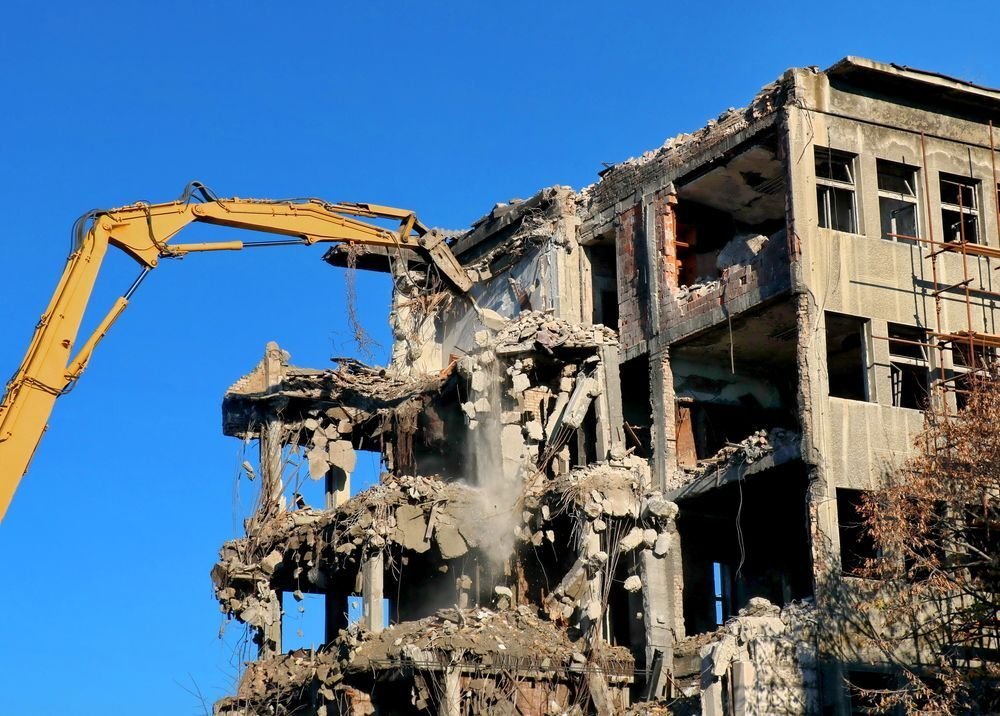
Structural demolition takes a building down in a planned sequence, usually with excavators with attachments, and sometimes with cranes and wrecking equipment for tall structures. Site demolition covers pavements, foundations, footings, underground tanks and utilities. Utility disconnects are coordinated in advance with each provider so that gas, water, sewer and electrical services are shut off and capped to the owner's and the provider's requirements.
Planning the sequence and the hand-off
We write a demolition plan for every project: what comes down, in what order, how the structure remains stable, where debris goes and how the site is protected. The plan is submitted to the building department when required and shared with the owner's team. We confirm that the next phase can start the day demolition ends, whether that is mass grading or foundation work.
Recycling is part of the method. Concrete and asphalt can often be crushed and reused as base material, and steel, copper and other metals are sold for scrap. Sorting at the source reduces disposal costs and keeps debris out of the landfill. Where a site is large enough, on-site crushing saves haul trips.
Old buildings, old records and what lies beneath
Sites carry histories that drawings do not always show. Deer Trail's main street lost businesses in a June 1965 flood, and many of those buildings were never rebuilt, which is a reminder that vacant ground in older towns may hide foundations, cisterns or abandoned lines. Near Watkins, an earlier Skyline Airport with a runway of 5,200 feet was built in the early 1960s and closed by 1980, showing how land use shifts and why a historical review is worth doing before excavating.
We research prior use, locate utilities with records and ground-penetrating radar when needed, and open test pits where uncertainty is high. At the former Fitzsimons Army Medical Center, which closed on June 8, 1996, redevelopment has been a long, coordinated effort, a reminder that large, long-used sites reward careful investigation. We apply the same thinking to a single building lot.
What demolition costs depend on
Building size and construction type set the baseline: masonry and concrete take longer and generate more debris than light framing. Hazardous materials abatement, access restrictions, adjacent structures and haul distance can change the price greatly. The value of salvage and recyclable material offsets some cost, and market prices for scrap vary.
We quote demolition with clear inclusions and exclusions, unit prices for unforeseen conditions such as buried tanks and an allowance for abatement when the survey is not yet complete. Owners should also budget for the permits, utility fees and site restoration that follow. Our estimates identify those items so there are no gaps.
How demolition fits with other work
Demolition usually leads into renovation and adaptive reuse or new construction, and it is often the first activity on a site that will become a parking structure or a warehouse building. We coordinate with the next contractor so the handoff is smooth, and we serve owners in commercial real estate development who need predictable site turnover.
For occupied properties, we collaborate with the team that handles phased construction on occupied sites to protect what stays open. Whatever the purpose, our goal is the same: remove what must go, protect what must stay and leave a site that is ready for the next trade.
Walk the site with us before you schedule
Send the address, the building type and the next phase of work and we will prepare a demolition plan, a survey checklist and a price. Developers and owners across the metro rely on us to leave sites ready for what comes next.
Questions Owners Ask
What permits does demolition require?
Typically a demolition permit from the building department, and in many cases separate notifications for asbestos work and utility disconnects. Some jurisdictions require proof of utility shutoff, a neighbor notice or a dust control plan. We confirm requirements with the city or county before scheduling.
How long does it take to demolish a commercial building?
Small buildings can come down in days, while large structures take weeks once abatement is done. Abatement, utility disconnects and permit approval often take longer than the demolition itself, so we plan them first.
Can materials from the building be reused?
Yes. Concrete and asphalt can be crushed for base, metals are recycled and some fixtures and equipment can be salvaged. We provide recycling reports when the owner or a green building program requires them.
What if we find an underground tank or other surprise?
We stop work in that area, notify the owner and bring in the specialists who handle tank removal and any contaminated soil under the required procedures. Unit prices in the contract set the cost basis for those discoveries.
How do you protect adjacent buildings?
We survey and photograph neighboring structures before starting, install barriers and dust controls, monitor vibration where necessary and sequence work to avoid undermining adjacent foundations. Clear communication with neighbors prevents most complaints.