
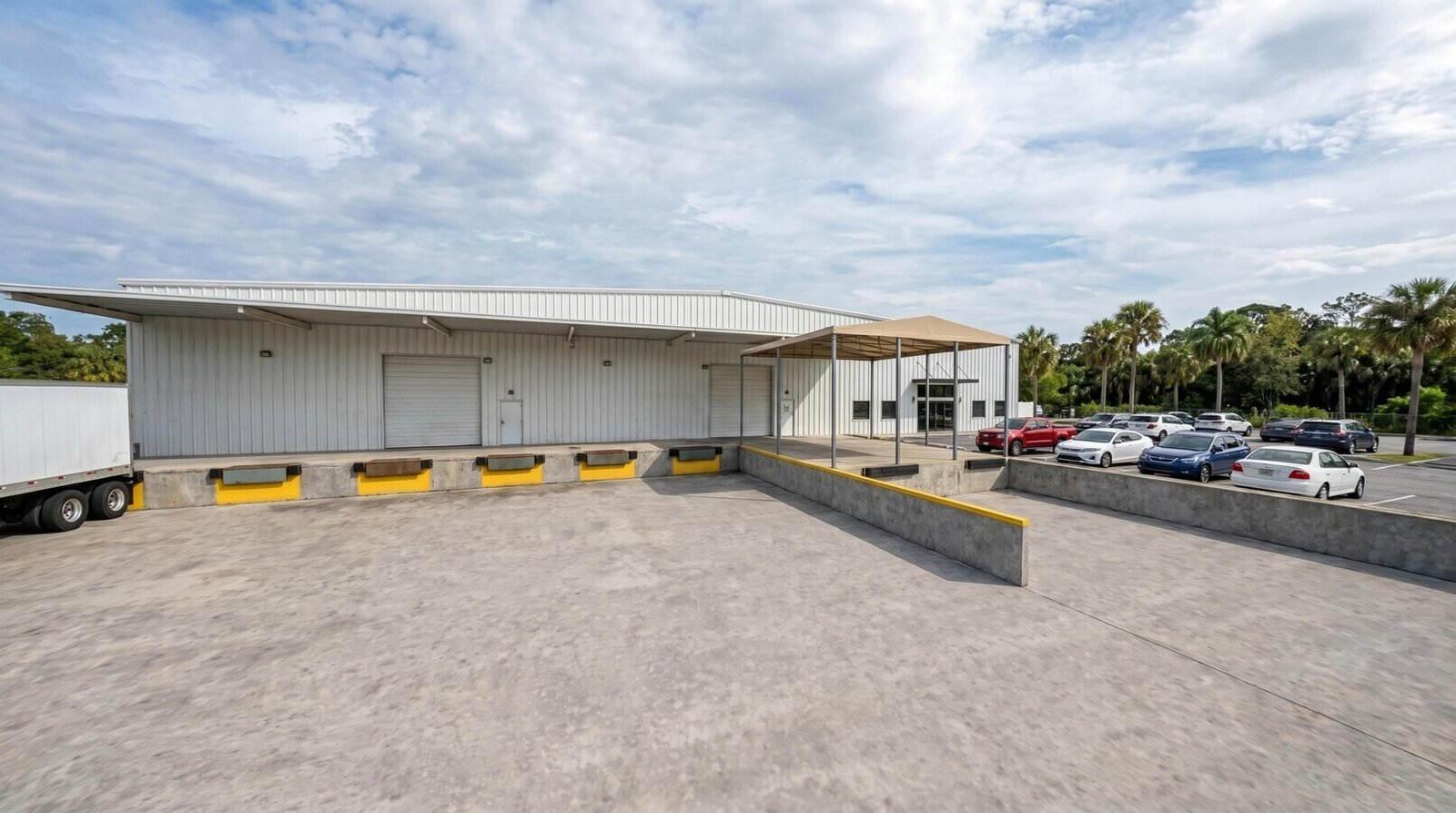
Truck Courts and Dock Aprons for Industrial Buildings in the Aurora Area
Concrete truck courts, dock aprons, trailer parking and dock pits for warehouses and distribution buildings along E-470 and I-70 east of Aurora.
Rocky Mountain Rail Park covers 620 acres beside Manila Road and I-70, and Port Colorado is a 6,500-acre master-planned development along the Union Pacific Railroad, mostly north of the interstate. Buildings that rise on land like that live and die by how trucks move around them. The dock apron, the truck court and the trailer parking are the working surface of every distribution building, and they take more abuse than any other part of the site.
We construct those surfaces for owners and developers who need pavement that handles loaded trailers, landing gear, turning movements and years of braking, without rutting or joint failure. Our scope runs from subgrade preparation to dock pits, apron slabs, concrete truck courts, trailer stalls, bollards and striping.
The work looks simple from the road, and it rarely is.
Why truck courts matter on this side of the metro
The east and southeast metro has become a freight and logistics location. E-470 provides Aurora exits at Smoky Hill Road, Quincy Avenue, 6th Parkway and I-70/Colfax Avenue, plus Peña Boulevard at exit 28 for Denver International Airport. Rail-served industrial land near the Colorado Air and Space Port adds a second mode, and building owners expect truck circulation that matches that connectivity.
More activity means more trailers per dock door per day, and developers who plan for that early avoid expensive repairs. Speculative owners need a court that satisfies the widest range of tenants, while build-to-suit clients can tune the design to specific truck types. We discuss both options at preconstruction, using the criteria described in our warehouse construction and distribution center construction work.
What we build, from dock pit to trailer stall
Dock work begins with the pits and leveler frames, which are formed and placed with the structure and must be accurate to the inch for equipment to fit. The dock apron slab, often thicker than the building floor and heavily doweled, runs out from the dock face to carry the landing gear of parked trailers and the dynamic loads of braking trucks. Concrete is commonly used here because asphalt can rut under the point loads of trailer legs.
The truck court beyond the apron is either reinforced concrete or heavy-duty asphalt, selected on the basis of loads, budget and tenant needs. We form and finish concrete courts with sealed or sawn joints placed to control cracking, add slope for drainage, install bollards and wheel stops, and stripe stalls and lanes. Drive lanes for passenger vehicles are often built in lighter sections, an approach we compare with the standards in our parking lot construction work.
Subgrade first, then joints, then slope
The most common cause of truck court failure is not the concrete itself but the ground beneath it. We proof-roll the subgrade, correct soft areas, compact the base to specification and verify drainage before forms go in. Clay soils that swell and shrink are managed with moisture conditioning and, where the engineer requires, a treated or thicker base.
Joint design follows the same logic. Panels are sized to control cracking, load-transfer dowels are placed to line up across joints, and sawing happens early enough to avoid random cracks. Slopes of a percent or two move water away from the dock face, and we shoot grades at each stage rather than relying on a final survey. The design coordinates with the commercial concrete floors inside the building so that interior and exterior slabs meet cleanly at the doors.
Buildings that depend on the court
Our truck court experience applies to many building types, but a few depend on it more than others. A truck terminal and cross-dock may have doors on both sides and trailers in constant motion. Distribution buildings have the highest ratio of truck positions to floor area, and food processing or cold storage facilities add washdown and drainage requirements.
Manufacturing plants, flex buildings and retail distribution centers have their own patterns. The key is to ask the operator how many trucks, of what type, at what hours, and to design the surface and the circulation around the answer.
What affects the price of a truck court
Concrete thickness, reinforcement, joint hardware and subgrade treatment drive most of the cost. Area is the other big variable: a deep truck court with trailer parking can exceed the building footprint on some sites. Drainage structures, retaining walls where grade changes and lighting conduit add to the total, as do winter placement costs.
We help owners find savings without damaging performance. A heavy section may be needed only at the dock apron and the turning radii, while lighter pavement can serve car parking and overflow stalls. Phasing the trailer parking into a later phase can also reduce initial capital. We lay these options out in a clear alternate list so owners can decide.
Where we build these surfaces
We work along the I-70 and E-470 industrial belt, near the Colorado Air and Space Port and through Aurora, Brighton and the southeast metro. Rail park land such as Rocky Mountain Rail Park, a 620-acre site that received final development plan approval from the Adams County commissioners in September 2020, sits on the eastern edge of that belt.
Owners in logistics and distribution often ask for conceptual court layouts and budget numbers before they finalize a site. We are happy to review the site plan, comment on truck turning and dock positions, and provide a cost range early.
Walk us through your site plan
Share the plan and truck counts and we will test the apron, court and trailer layout before you lock the site. You can also see how our cold storage construction capabilities pair with dock-heavy projects.
Questions Owners Ask
Is concrete or asphalt better for a truck court?
Concrete handles the concentrated loads of trailer landing gear and braking much better, so it is standard at dock aprons. Asphalt can work in lanes with moving traffic if the section is heavy and the subgrade is strong. Many owners use a hybrid: concrete at the docks and turning areas, asphalt elsewhere.
How deep should a truck court be?
The depth depends on the trailer length, the turning radius, whether trailers will be parked in front of the doors and city requirements. Many modern distribution buildings use courts well over 100 feet deep from the dock face. We review the geometry with the civil engineer and test it with a turning template.
How long do concrete aprons last?
With a strong subgrade, correct joints and good drainage, they can serve for decades with minimal repair. The typical problems are joint sealant failure and localized settlement. We recommend a routine inspection and joint maintenance program.
Can truck courts be built in winter?
Concrete placement in cold weather is possible with protection, but it costs more and slows progress. If the schedule allows, we try to place critical slabs in milder months and use the winter for subgrade work, drainage and building construction.
What permits do truck court projects require?
The courts are generally reviewed as part of the site plan and grading and drainage plans. Cities and counties in this metro may also review truck circulation, lighting and landscape screening. We track each item through the municipal review.